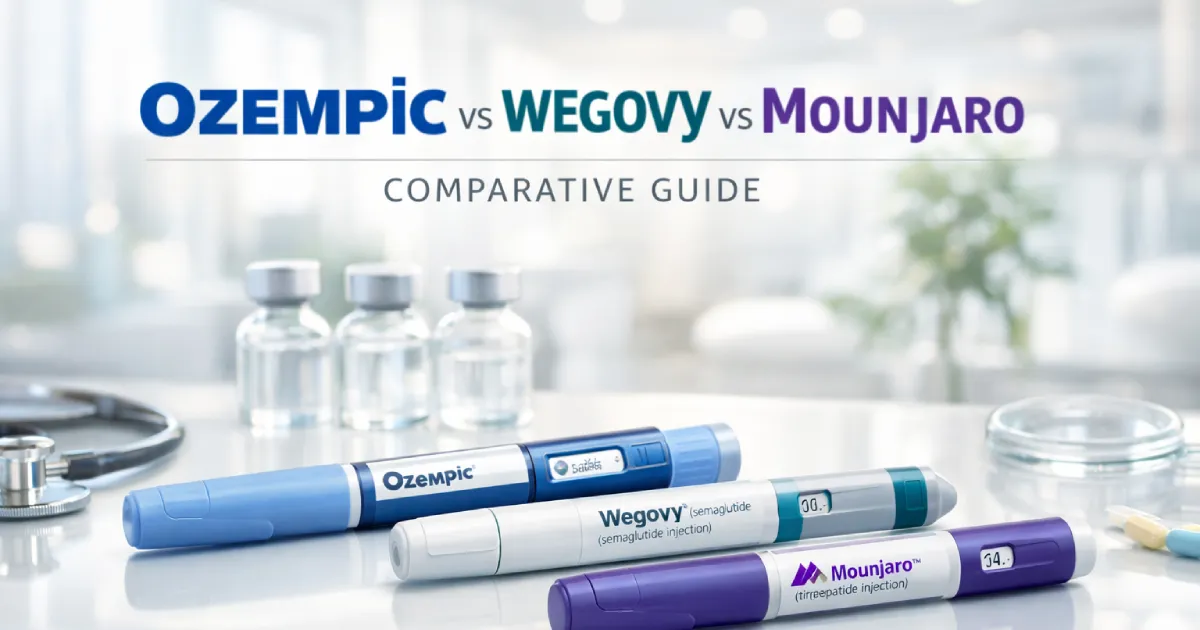
Ozempic, Wegovy, and Mounjaro: A Comparative Guide for Patients
Patients comparing these brands are often told they are "basically the same." That shortcut is not good enough. They overlap, but their molecules, FDA-approved uses, dosing frameworks, and clinical intent are not identical. This guide explains the differences in plain English while keeping the medical nuance intact.
Clinical Context
Ozempic and Wegovy both contain semaglutide, but they do not carry the same FDA label or the same primary clinical intent. [1] [2]
Mounjaro contains tirzepatide, which activates both GIP and GLP-1 receptors, while the obesity-focused tirzepatide brand is Zepbound. [3] [4]
In real practice, the right choice depends on the condition being treated, comorbidities, side-effect tolerance, titration strategy, and insurance rules — not whichever brand is trending online.
Medical disclaimer: This article is for educational purposes only and is not medical advice. Always follow your own clinician's plan and the approved prescribing information for your exact medication.
Executive Summary
The short version patients should understand first
Ozempic and Wegovy are both semaglutide products. That means they share the same core molecule and the same broad drug class: a GLP-1 receptor agonist. But they are not simply interchangeable labels. Ozempic's FDA indications center on type 2 diabetes and certain cardiovascular and kidney-risk outcomes within specific type 2 diabetes populations, while Wegovy is the semaglutide brand built for chronic weight management and other current label indications. [1] [2]
Mounjaro is different at the molecule level. Its active ingredient is tirzepatide, not semaglutide, and tirzepatide is a dual GIP and GLP-1 receptor agonist. In simple terms, that means it activates two incretin-related signaling pathways instead of one. The diabetes brand for tirzepatide is Mounjaro. The obesity-focused tirzepatide brand is Zepbound. [3] [4]
That distinction matters because patients, clinicians, and insurers are not choosing between brand names in the abstract. They are choosing a treatment path that matches a diagnosis, a risk profile, a tolerance pattern, and a payer system.
A common online mistake is to compare these products only by social buzz or body-weight anecdotes. A better comparison starts with the label: what the product is approved to treat, how it is titrated, and which patient populations were studied.
Mechanism Comparison
Why semaglutide and tirzepatide are related — but not identical
Semaglutide — the active ingredient in Ozempic and Wegovy — selectively binds to and activates the GLP-1 receptor. GLP-1 is an incretin hormone involved in glucose regulation, appetite signaling, and caloric intake. That is why semaglutide therapy can influence blood sugar, hunger, and body weight at the same time. [1] [2]
Tirzepatide — the active ingredient in Mounjaro and Zepbound — activates both the GIP receptor and the GLP-1 receptor. GIP is another incretin hormone. On the current FDA label, tirzepatide is described as selectively binding to and activating both receptors, with nonclinical evidence suggesting the GIP component may further contribute to the regulation of food intake. [3] [4]
In patient-friendly language, semaglutide works through one major incretin pathway, while tirzepatide works through two. That does not mean dual agonism is automatically "better" for every person. It does mean the medicines are not identical in how they signal through the gut-brain-pancreas axis, which is one reason different patients may respond differently in efficacy, appetite change, glycemic response, and tolerability.
| Medication | Active Ingredient | Primary FDA Indication | Mechanism |
|---|---|---|---|
| Ozempic | Semaglutide | Type 2 diabetes; cardiovascular and kidney-risk reduction in type 2 diabetes populations | GLP-1 receptor agonist |
| Wegovy | Semaglutide | Chronic weight management and current semaglutide obesity-related label indications | GLP-1 receptor agonist |
| Mounjaro | Tirzepatide | Type 2 diabetes | Dual GIP and GLP-1 receptor agonist |
| Zepbound | Tirzepatide | Chronic weight management; obesity-related obstructive sleep apnea | Dual GIP and GLP-1 receptor agonist |
The table includes Zepbound because patients comparing Mounjaro are often really comparing tirzepatide as a molecule across its diabetes and weight-management brands. [3] [4]
While these medications are related, they do not act through identical receptor patterns. That is one reason some patients feel noticeably different on tirzepatide than on semaglutide, even when both are taken once weekly and both affect appetite.
Approval Distinction
The FDA-label difference is the credibility anchor
Ozempic is FDA-approved as an adjunct to diet and exercise to improve glycemic control in adults with type 2 diabetes. Its current label also includes reduction of major adverse cardiovascular events in adults with type 2 diabetes and established cardiovascular disease, as well as reduction of sustained eGFR decline, end-stage kidney disease, and cardiovascular death in adults with type 2 diabetes and chronic kidney disease. [1]
Wegovy is the semaglutide brand associated with chronic weight management. On the current FDA label, Wegovy is indicated in combination with a reduced-calorie diet and increased physical activity to reduce excess body weight and maintain weight reduction long term in qualifying patients, and it also carries cardiovascular risk-reduction language in adults with established cardiovascular disease and overweight or obesity. The current label also includes a noncirrhotic MASH indication under accelerated approval. [2]
Mounjaro is FDA-approved as an adjunct to diet and exercise to improve glycemic control in adults and pediatric patients aged 10 years and older with type 2 diabetes. It is not the obesity-label brand for tirzepatide. That role belongs to Zepbound, which is the tirzepatide brand indicated for chronic weight management in qualifying adults and, on the current label, for moderate to severe obstructive sleep apnea in adults with obesity. [3] [4]
For patients, the practical message is simple: the active ingredient matters, but the label matters too. The same or related molecules may be packaged under different brand names because the studied population, approved indication, and clinical objective are not exactly the same.
High-quality health content uses language like "FDA-approved for" carefully. Readers should be able to tell at a glance whether a brand is being discussed for its official indication or for broader public conversation around the molecule.
Dose Escalation
How dose titration works across all four brands
Every medication covered in this guide — Ozempic, Wegovy, Mounjaro, and Zepbound — requires gradual dose escalation. None of them is started at the full therapeutic dose on day one. The reason is pharmacological: GLP-1 and GIP/GLP-1 receptor agonists influence gastric emptying, appetite signaling, and glucose regulation in ways that need time to adapt. Starting too high, too fast, dramatically increases the likelihood of nausea, vomiting, and other gastrointestinal adverse effects that lead to early treatment discontinuation.
Semaglutide (Ozempic and Wegovy) and tirzepatide (Mounjaro and Zepbound) each have their own FDA-approved titration schedules. Those schedules differ across brands, which is another reason a dose from one product label cannot simply be copied to another. The loading dose, escalation intervals, and maintenance targets are product-specific. [1] [2] [3] [4]
If titration is managed well, the majority of gastrointestinal side effects are mild to moderate and improve over time. If it is rushed — whether because of patient impatience, miscommunication, or formulary pressure — the risk of intolerable side effects rises and adherence suffers before the treatment has had a chance to work.
Related MedaDose Guide
The GLP-1 Titration Guide: Why Slow Dose Escalation Matters
Deep-dive into how semaglutide titration works, what a standard dose progression looks like, and why going too fast undermines adherence.
Clinical Data Snapshot
What the evidence base looks like at a glance
Cross-trial comparisons are imperfect because studies enrolled different populations, used different endpoints, and tested different doses. The safest way to read the evidence is to understand what each trial was designed to answer.
| Product / Molecule | Evidence Snapshot | What It Means Clinically |
|---|---|---|
| Ozempic / semaglutide | Current labeling reflects glycemic-control data plus cardiovascular and kidney outcomes data in type 2 diabetes populations. | Best understood as a diabetes-centered semaglutide brand with important cardiorenal context, not the primary branded semaglutide weight-management label. [1] |
| Wegovy / semaglutide | STEP 1 showed clinically meaningful weight reduction with once-weekly semaglutide 2.4 mg in adults with overweight or obesity, and SELECT showed reduced major adverse cardiovascular events in adults with overweight or obesity and established cardiovascular disease without diabetes. | The evidence base aligns Wegovy with obesity medicine and cardiometabolic risk reduction, not just cosmetic weight change. [5] [8] |
| Mounjaro / tirzepatide | SURPASS-2 found tirzepatide noninferior and superior to semaglutide 1 mg for HbA1c reduction in adults with type 2 diabetes on metformin, with body-weight reduction also favoring tirzepatide in that trial. | Mounjaro's diabetes story is strong, but the brand itself remains diabetes-labeled. [6] [3] |
| Tirzepatide obesity / Zepbound | SURMOUNT-1 showed substantial and sustained weight reduction in adults with obesity without diabetes, and a later head-to-head trial reported tirzepatide superior to semaglutide for body-weight reduction in adults with obesity without diabetes. | For patients specifically focused on obesity treatment, the weight-management tirzepatide brand is Zepbound. [7] [9] [4] |
For patient education, the most important rule is to avoid shallow cross-trial thinking. A dramatic number from one study does not automatically translate into the right decision for an individual patient in clinic. The better framework is to ask: What condition is being treated? What dose was studied? Which brand matches the label? What outcomes matter most for this person right now?
Head-to-head data can be informative, but labeling still matters. A molecule can perform well in a study without that automatically making every brand version appropriate for every patient goal or payer pathway.
Patient Preparation
Questions to ask before you start
Walking into a prescribing conversation with the right questions changes the quality of the clinical decision. These are the questions patients ask most often — and the ones that most commonly reveal what the right choice really is.
- 1Which brand is FDA-approved for my primary diagnosis — diabetes, obesity, or both?
- 2Does my current insurance cover this product under a diabetes or obesity pathway, and does that affect which brand we choose?
- 3What is the starting dose, and how long does the escalation phase typically take?
- 4What side effects should I expect during dose escalation, and at what point should I call you?
- 5Do I have any history — pancreatitis, gallbladder disease, retinopathy, thyroid — that affects which product is appropriate for me?
- 6If I switch from one brand to another, do I restart at the beginning of the escalation schedule?
- 7How long will it take to know whether this treatment is working for my goals?
- 8What happens if I miss a dose on this specific product?
The Trust Anchor
Why the prescribing clinician's role is still central
In real-world care, the choice between Ozempic, Wegovy, Mounjaro, and related brands is rarely made on a single axis. Clinicians consider diagnosis, HbA1c patterns, cardiovascular disease, chronic kidney disease, obesity severity, sleep apnea context, prior response to incretin therapy, gallbladder history, GI tolerance, retinopathy context, and the patient's capacity to stay adherent during titration. [1] [2] [3] [4]
Insurance coverage also matters more than many patients expect. Two medications may look similar on social media but live in totally different payer buckets. Prior authorization language, diagnosis coding, formulary preference, step therapy, and supply access can all influence what is realistically available.
The best prescribing decisions are therefore not purely pharmacologic and not purely financial. They are integrated decisions that weigh clinical intent, patient safety, adherence, tolerability, and access. That is exactly why a clinician who knows the patient's full metabolic profile remains the trust anchor.
Patient-Centric FAQ
The practical questions patients actually ask
Conclusion
What patients should remember
Ozempic, Wegovy, and Mounjaro belong to the same broad modern metabolic-treatment conversation, but they are not interchangeable shortcuts. Ozempic and Wegovy both use semaglutide but serve different label-driven purposes. Mounjaro uses tirzepatide and adds GIP agonism to GLP-1 activity. And when tirzepatide is discussed in the context of weight management, the approved brand patients usually need to understand is Zepbound. [1] [2] [3] [4]
The most reliable way to navigate these options is not to ask which name is most famous. It is to ask which product matches the diagnosis, the goals, the label, the safety profile, and the practical realities of coverage and follow-up.
And because every one of these medications requires careful dose escalation, understanding titration is not optional — it is the foundation of safe, effective metabolic therapy.
Stay informed with evidence-based metabolic health education
Get clinically grounded dosing insights, adherence guidance, and new MedaDose guides delivered straight to your inbox. No spam — unsubscribe any time.
MedaDose Editorial Team — Health Researcher
This article was prepared by the MedaDose Editorial Team using current FDA labeling and major peer-reviewed trial references. It is designed to help patients ask better questions and make more informed decisions with licensed healthcare professionals.